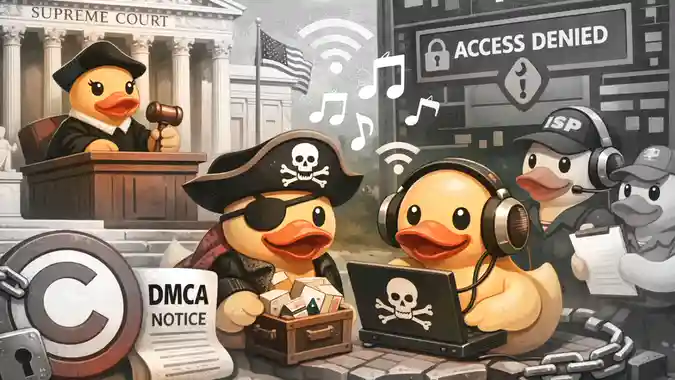
The U.S. Supreme Court has handed internet providers a major copyright win. In Cox Communications, Inc., et al. v. Sony Music Entertainment et al., decided on March 25, 2026, the Court held that an ISP is not liable for user copyright infringement based on knowledge alone. For readers who have not followed the case, this was a long-running fight over a basic question: when subscribers pirate music, can the company providing their internet connection be forced to pay for it too?
The short version of the case
The dispute began years ago when Sony Music and other record labels accused Cox of contributory copyright infringement. Their argument was not that Cox copied or shared songs itself. It was that Cox allegedly knew many subscribers were infringing through BitTorrent, received large numbers of infringement notices, and still failed to do enough to stop repeat offenders.
That theory produced one of the most closely watched copyright verdicts against an internet provider. In 2019, a jury in Virginia awarded more than $1 billion in damages against Cox. The case then moved through the appeals process and eventually reached the Supreme Court because it raised a broader legal issue with consequences far beyond one company: what does an ISP have to do before it becomes responsible for what its users do online?
On March 25, 2026, the Supreme Court reversed the core theory behind that verdict. The Court said that mere knowledge of infringement is not enough.
What the Supreme Court actually held
According to the Supreme Court’s syllabus and opinion, contributory copyright liability requires proof that the provider intended the infringement to happen. The Court said that intent exists only in limited circumstances.
First, a provider can be liable if it actively induces infringement, in other words if it encourages or promotes piracy. Second, it can be liable if it offers a service specifically tailored for infringement. A general broadband connection does not meet that test.
That is the key line in plain English: an ISP does not become a copyright infringer simply because it knows some customers are pirating content and continues to provide internet access.
This does not make piracy legal. It does not prevent copyright holders from going after direct infringers. It also does not protect services that are designed to facilitate infringement. What it does is make it much harder to hold a broadband provider liable just because infringement happens on its network and the company knows that some of it is happening.
Why the ruling matters for ISPs and users
The practical effect is significant. Copyright owners now face a higher bar when suing internet providers over subscriber activity. The Court’s approach narrows the circumstances in which a provider can be treated as a participant in infringement rather than a conduit carrying traffic.
That matters because a broader liability rule would have created strong incentives for ISPs to behave more aggressively toward subscribers after receiving infringement notices. In practice, that could have meant more account suspensions, more terminations, and more pressure to treat allegations as proof.
The ruling therefore speaks to a larger policy question: should internet infrastructure be expected to police user behavior, or should that responsibility stay closer to the people and services directly involved in the infringement? The Court clearly leaned toward the second view.
One way to frame the signal is this: the network layer is not automatically a copyright cop. The provider’s role as a conduit still matters in the Court’s analysis.
Why this is interesting beyond the United States
The decision is a U.S. ruling, not a global rule. But it will still attract attention far beyond the United States because debates about intermediary liability are international, and internet culture is not neatly contained by national borders.
For years, policymakers, courts, creators, rights holders, and digital-rights advocates have argued over how much responsibility should sit with intermediaries. That includes platforms, hosts, search tools, and access providers. This case does not settle those debates everywhere, and it does not map perfectly onto regimes outside the United States. Still, it reinforces a familiar idea in web policy: there is an important difference between a service built to encourage infringement and a general-purpose service that lawful and unlawful users both rely on.
That distinction matters to the culture of the web because enforcement rules do not stay abstract for long. They shape how dorm networks are managed, how shared household connections are treated, how libraries and public access points handle complaints, and how comfortable providers feel cutting users off after repeated notices.
In that sense, the ruling is about more than music piracy. It touches a longstanding argument about whether the architecture of the internet should remain relatively neutral at the infrastructure level or whether copyright enforcement should move further down into the pipes.
Early reaction on X, with some caution
Early reaction on X, at least in the material circulated around the ruling, was highly celebratory. Much of it framed the decision as a win for “the internet,” for users, and for a more open network. Memes about piracy culture, anime, and The Pirate Bay appeared quickly in the replies to the widely shared post from @scotus_wire.
That reaction is interesting, but it should be read carefully. Social-media replies are not a scientific measure of public opinion, and meme-heavy discourse often compresses legal nuance into a simple cultural signal. The actual ruling did not legalize piracy, and it did not say every intermediary is protected in every situation. What it did was reject liability based on knowledge alone and require something closer to intentional participation.
Still, the celebratory tone is revealing. Cases like this often become symbolic fights about who gets to govern online behavior: users, platforms, rights holders, regulators, or infrastructure providers. That is one reason the decision resonated so quickly outside specialist legal circles.
What to retain
For readers catching up, the core takeaway is straightforward. The Supreme Court’s March 25, 2026 decision in Cox v. Sony says that an ISP cannot be held liable for subscriber copyright infringement simply because it knew infringement was happening. The Court requires proof of intent, such as active inducement or a service specifically tailored for infringement.
That makes the ruling a major win for broadband providers and an important setback for a more expansive copyright-enforcement theory. It also makes the case worth watching beyond U.S. law, because it adds weight to a broader principle that keeps returning in internet policy: the question of when the companies carrying traffic stop being conduits and start being treated as responsible actors in what users do online.
Comments