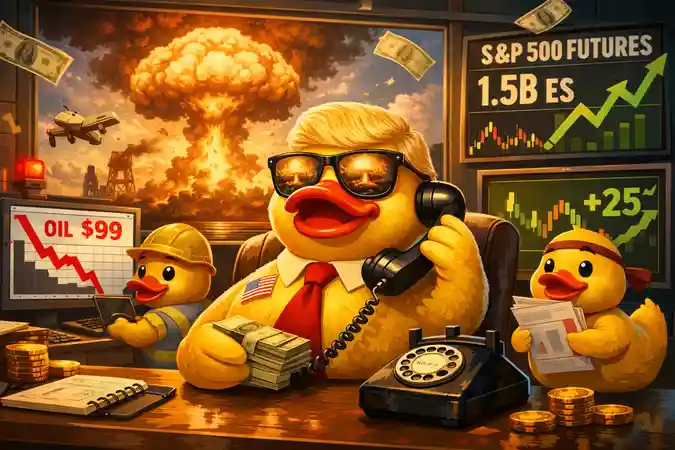
A burst of futures trading just minutes before Donald Trump’s March 23, 2026 statement on Iran has opened a wider question than one suspicious market move. It has drawn together market structure, presidential communication, geopolitical signaling, and a familiar Trump-era suspicion: that abrupt policy reversals can create a private trading edge for people closest to the signal.
What happened before Trump’s March 23 Iran post
The core sequence is not in serious dispute.
On Monday, March 23, 2026, unusually large sell orders hit crude oil futures shortly before Trump posted on Truth Social that he would delay military action against Iran for five days and that “productive conversations” were under way. Oil prices fell sharply after the message. Equity futures moved the other way.
Reuters reported that traders sold more than $500 million worth of Brent and WTI crude futures between 10:49 and 10:50 GMT, about fifteen minutes before Trump’s post at 11:05 GMT. Reuters, citing LSEG data, described roughly 5,100 Brent and WTI lots trading in that one-minute window. After Trump’s message, oil slumped, with Brent falling from about $112 to $99 and WTI from about $99 to $86 during the immediate reaction. That timing is why the oil leg of the story became the most documented part of the episode.
A second figure then spread rapidly across market media and social platforms: roughly $1.5 billion in E-mini S&P 500 futures, usually referred to by traders as ES futures, bought shortly before the same post. That number was widely cited, including in Fortune and The Times. It became part of the viral framing because it paired neatly with the oil trade: short crude, long equities, then wait for the policy reversal.
The shape of the trade is what made the whole sequence look so clean. A softer Iran line would normally relieve fear in the oil market while lifting risk assets. The minutes before Trump’s post appear to show exactly that positioning.
The $1.5 billion ES futures figure, and why it matters
The $1.5 billion ES number deserves attention, but also precision.
In public reporting, the oil figure is better documented than the ES figure. Reuters provided a detailed account of the oil trades using LSEG market data. By contrast, the $1.5 billion estimate for ES futures appears to have circulated first through market watchers and social-media amplification before being repeated in press coverage. That does not make it false. It does mean readers should distinguish between a figure backed by a clearly described data source in a major wire report and a figure that became prominent through a mix of newsroom reporting and market-intelligence accounts.
That distinction matters because the ES number quickly became central to the public story. The image it creates is powerful: not just one suspicious oil trade, but a two-legged macro bet placed shortly before a President moved both markets at once.
It also matters because this was not just any trading window. Pre-market and off-peak futures trading can be thinner than the core session. In those conditions, an outsized order stands out more sharply. A large directional bet before a known market-moving event can look dramatic even when it is not illegal. But the more isolated, better timed, and better aligned the order flow appears, the more the suspicion shifts from ordinary speculation toward information asymmetry.
That is why the ES figure, even with less public granularity than the oil block, became so central to the debate.
Why the episode fits the “TACO trade” discussion
This story did not land in an empty market.
By March 2026, Wall Street was already using the phrase TACO to describe a recurring pattern: Trump escalates, markets wobble, then Trump softens or reverses course and risk assets rebound. Reuters had already written on March 23 that oil itself was beginning to “price for Trump to deliver the TACO.” The phrase had circulated widely in financial commentary before this Iran episode hardened it into something more politically combustible.
That broader context matters because it changes how traders interpret sudden White House messaging. In a market that has learned to expect reversals, even non-public information is no longer the only possible edge. Repetition can create its own trading logic.
But that same repetition creates a different problem. Once presidential communication becomes a recognizable market pattern, every sharp reversal invites the same question: who saw it coming, and how?
That is one reason the @abetrade post resonated so quickly. The trader used a sarcastic formulation to call out the “outsized” and “very suss” ES futures buying roughly ten minutes before Trump’s Iran announcement, adding a joking caveat about not endorsing insider trading “in any way, shape, or form.” The tone was flippant. The point was not. In trading circles, the move was being read not as a clever macro call in the abstract, but as something that looked almost too perfectly timed.
The outsized buying of ES futures just 10 minutes before Trump's announcement is definitely very suss.\n\nIn no way, shape, or form do I support insider trading. It's terrible for the free markets.\n\nUnless, of course, I'm made aware of the news in advance as well. Then it's...
— Adam (@abetrade) March 23, 2026
Paul Krugman’s “treason” line, and the bigger political reading
The viral rhetorical peak came from economist Paul Krugman, who argued on March 24, 2026 that exploiting confidential national-security information for profit amounted to “treason.” That language helped catapult the story beyond financial media into political discourse.
Legally, “treason” in the United States has a narrow constitutional meaning. Politically, however, Krugman’s wording sharpened the underlying fear: that information about war, peace, strikes, or reversals might be monetized before it reaches the public.
The larger political reading does not depend on adopting Krugman’s wording. What gives the story staying power is the possibility that Trump’s flip-flop communication style can itself create structured advantages for people close to the signal.
That idea appears in several layers.
The first layer is straightforward market mechanics. If a President repeatedly jolts markets with maximalist rhetoric and then abrupt retreats, people with better access to tone, timing, internal debate, or decision-making cadence may gain an edge over everyone else.
The second layer is political proximity. Even absent a proven leak, a communication ecosystem built around allies, informal advisers, friendly media channels, and loyal networks naturally raises the question of unequal access. If market-moving reversals occur in a recognizable pattern, proximity itself becomes valuable.
The third layer is public trust. A White House message about Iran is not supposed to look like a tradable release valve for oil shorts and equity longs. Once it does, even intermittently, the damage is larger than one trade.
The on-chain angle and the search for whistleblowers
The suspicion has not remained confined to traditional futures markets.
Since late 2025, crypto traders, on-chain analysts, and prediction-market observers have repeatedly flagged suspiciously well-timed bets ahead of Trump-related announcements or geopolitical turns. That has included large directional positions in crypto derivatives and notable activity on platforms such as Polymarket. The evidence has varied in strength from case to case, but the cumulative effect has been to normalize a new kind of market vigilance: watch the wallets, watch the futures, then wait for the post.
That is also why a familiar question now appears in forums and comment threads: where are the whistleblowers?
The question is not idle. In the United States, both the SEC and the CFTC maintain formal whistleblower channels. The SEC’s process allows people with information about possible securities-law violations to submit a Tip, Complaint, or Referral. The CFTC has a parallel framework for commodities and derivatives, which is especially relevant in a case centered on oil futures. Both agencies describe confidentiality protections on their sites, and both systems are designed for people who may have non-public information from inside firms, trading desks, intermediaries, or related institutions.
That does not mean a whistleblower exists here, or that any one person necessarily knows the whole chain. A suspicious market event can arise from a direct leak, a partial tip, a fragmented network, or aggressive inference by traders who have learned a political pattern unusually well. Still, the repeated appearance of the whistleblower question says something important on its own: a growing share of the public now treats market anomalies around Trump announcements as the kind of events that ought to generate formal disclosures, not just social-media outrage.
Why this episode has lingered
Some stories fade because the mechanics are too obscure for anyone outside the market to care. This one has lingered because the mechanics are easy to grasp.
A President threatened force. Then he changed tone. Just before that reversal became public, very large positions appeared in markets that stood to benefit from exactly that change.
The Iran story also arrived at a moment when Trump’s style was already being converted into trading shorthand. Once a pattern like TACO enters the financial lexicon, suspicious timing no longer looks like an isolated curiosity. It looks like a market structure problem attached to political power.
That is what gives this episode its unusual charge. It is not only about whether someone placed a profitable bet before a market-moving message. It is also about what happens when presidential communication becomes so volatile, so repeatable, and so financially consequential that markets start to treat reversals as a tradeable feature of governance.
Sources
- Fortune: Paul Krugman says suspicious trading before Trump’s Iran reversal could amount to “treason”
- Reuters: Traders bet $500 million on oil price just before Trump’s post on delay to Iran attack
- Reuters: Crude oil’s Catch-22: pricing for Trump to deliver the TACO trade
- Paul Krugman on Substack: “Treason in the Futures Markets?”
- The Times: Oil trades of $500m made minutes before Trump statement
- Axios: Wall Street’s “Trump pressure” index
- The Guardian: Bets on a US-Iran ceasefire showed signs of possible insider knowledge, experts say
- Cornell Law School: U.S. Constitution, Article III, Section 3 on treason
- SEC whistleblower program: information about submitting a tip
- CFTC whistleblower program: filing a Form TCR
- X post by @abetrade discussing the “outsized” and “very suss” ES futures buying before Trump’s Iran announcement
Comments